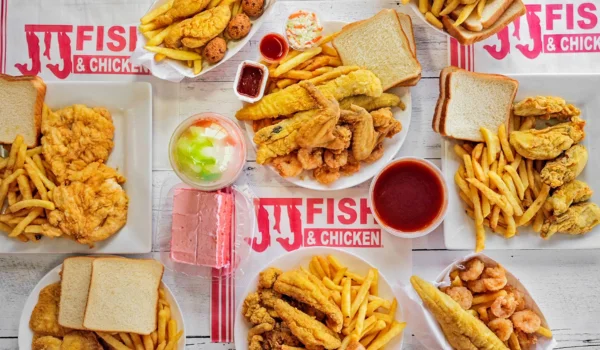
JJ Fish & Chicken (consumer site) presents itself as a fast-casual/fast-food chain offering fried fish, shrimp, catfish, chicken wings/tenders, combos and sandwiches. The menu and site positioning target takeout, delivery and quick dine-in customers. The brand appears regionally active and consumer-facing, but the company site does not publicly display a full franchise disclosure pack for U.S. franchising.
Is JJ Fish & Chicken a franchised brand (publicly)?
- The brand operates multiple locations (see their site), but public franchise disclosure information for the U.S. (FDD or Itemized investment table) is not published on the consumer site. That means prospective buyers must request the FDD and ask for Item 19 (financial performance) and Item 20 (franchisee list) directly from the franchisor.
For other “JJ” branded chicken systems (international expansions) you’ll see explicit franchising pages and fee levels (for example, JJ Chicken has posted franchise options and fee ranges in other markets). Those international figures can provide context but are not a substitute for the U.S. FDD.
How much does a JJ Fish & Chicken franchise cost? (Estimated)
Because JJ Fish & Chicken doesn’t publish an FDD online, below are industry-grounded estimates and comparable-brand benchmarks you should use when planning:
Franchise Fee (expected)
- Estimate: $20,000 – $50,000 (typical for regional QSR concepts).
(Exact fee — if any — must be confirmed in the FDD.)
Total Initial Investment (U.S. QSR style)
- Estimate range: $180,000 – $400,000
This includes: franchise fee, leasehold improvements, kitchen equipment (fryers/hoods/refrigeration), POS, signage, initial inventory, pre-opening payroll, permits/licences, and 2–3 months working capital. Use the lower end if you pursue a delivery/ghost-kitchen or small kiosk; expect the upper end for full dine-in locations.
Smaller / Non-traditional Formats
- Ghost kitchen / delivery-only: can often be launched for $60,000 – $150,000 depending on location & buildout.
- Food truck / food cart: $40,000 – $120,000 depending on equipment and local regs.
These are planning ranges — not JJ Fish & Chicken’s promises. Ask the franchisor for a detailed Item 7 (estimated initial investment) in writing.
Ongoing fees you should expect
Typical fees across similar QSR seafood/chicken systems:
- Royalty: 4% – 7% of gross sales (industry norm).
- Marketing / Brand Fund: 1% – 3% of gross sales.
- Technology/Payment Fees: fixed or percentage (varies).
- Renewal Fee (at franchise term renewal): sometimes a percentage of original fee.
Important: Some international JJ-style franchise programs have shown royalty levels near 6% — useful as a comparator but not definitive for U.S. JJ Fish & Chicken. Confirm all ongoing fees in the FDD.
Revenue & profit potential — realistic view
- Gross sales for fish & chicken QSRs vary widely by trade area. Small carryout units in good locations may do $30k–$80k/month; larger dine-in units can do $70k–$140k+/month. Use conservative estimates for your pro-forma.
- Net profit margins (after COGS, labor, rent, royalties): typical mature QSR margins often fall between 10%–20%. New stores should plan for tighter margins during ramp-up months.
- Break-even: commonly 12–24 months depending on sales ramp, location and cost control.
Again: ask the franchisor for Item 19 (if available) or verified franchisee P&Ls to see real unit economics rather than relying on general benchmarks.
Space, formats & ideal locations
JJ Fish & Chicken-style concepts usually operate in these formats:
- Compact carryout / counter service (700–1,500 sq ft) — works well in suburban strip centers, near colleges, or high-traffic corridors.
- Full dine-in (1,500+ sq ft) — higher buildout, higher revenue potential.
- Non-traditional: ghost kitchen (delivery only) — lower fixed cost; rising model for urban areas.
- Mobile/food truck — good for events, festivals and brand testing.
Choose the format that matches local demand and budget. The franchisor should provide site criteria during discovery.
What support should JJ Fish & Chicken provide?
A credible franchise system typically delivers:
- Initial training (operations, food prep, safety, POS).
- Site selection assistance & opening support.
- Operations manuals & SOPs.
- Marketing templates, grand-opening support, and ongoing brand campaigns.
- Supply chain guidance (approved vendors, ingredient sourcing).
If the franchisor cannot commit to these in writing (in the FDD and franchise agreement), consider that a red flag.
Eligibility & financial requirements (what franchisors usually ask)
Expect franchisors to require:
- Sufficient liquid capital and net worth to cover the total investment plus reserves (benchmarks vary; inquire for JJ’s specific thresholds).
- Experience: restaurant experience helps but some systems accept first-time owners who will be operator/managers.
- Ability to secure a lease and meet local licensing (health, business, sign permits).
For comparable brands, franchisors sometimes require $100k+ liquid assets and net worth hurdles — but JJ Fish & Chicken’s specific requirements must be confirmed in their franchise packet.
Pros & cons (quick assessment)
Pros
- Familiar, high-demand menu (fried chicken + seafood) with strong takeout/delivery appeal.
- Relatively simple kitchen footprint vs full-service seafood restaurants.
- Multiple format flexibility (carryout, delivery, food truck).
Cons / Risks
- Public franchising info is limited — no readily available U.S. FDD on the consumer site, so you must request full disclosure.
- Seafood/fish costs and supply chain can be volatile and compress margins.
- Royalties and ad fees reduce net cash flow — confirm exact percentages.
Due-diligence checklist — what to request and verify (must do)
- Request the current FDD (at least 90 days before signing). Read Item 6, 7, 8, 11, 19, 20 and 21 carefully.
- Ask for Item 19 (Financial Performance Representations). If absent, insist on reviewed unit P&Ls from multiple franchisees.
- Obtain the list of current franchisees (Item 20) and call at least 5–10 franchisees — ask about real sales, start-up overruns, franchisor responsiveness, and ongoing support.
- Visit operating units during peak hours to inspect food quality and throughput.
- Get a detailed Itemized Project Cost (a line-by-line estimate from the franchisor or their approved contractor).
- Have a franchise attorney review the agreement and a CPA build a 12-month cashflow & break-even.
- Confirm supplier agreements and whether use of approved vendors is mandatory and how pricing is controlled.
- Negotiate milestones & refunds (e.g., franchise fee refundable if site is not approved).
If the franchisor resists sharing FDD items or franchisee contacts, treat that as a major red flag.
How to apply / next steps
- Contact JJ Fish & Chicken through their official site contact form or franchise inquiry (use the consumer website to request franchising info).
- Request the FDD and franchise kit.
- Complete franchisor application and supply financials.
- Schedule discovery calls, unit visits and reference checks.
- Finalize site, sign agreement, and begin buildout once terms are clear.
12) Final verdict
JJ Fish & Chicken represents a familiar, serviceable QSR concept (fried fish + chicken) with obvious market demand. However — because the brand does not publicly display a U.S. FDD on its consumer site — you must insist on full, written disclosure (FDD + Item 19) and speak with existing franchisees before proceeding. Use conservative pro-formas and plan for typical QSR startup costs (roughly $180k–$400k for a full unit in the U.S.) unless the franchisor provides concrete, lower Item 7 figures.
About the Author



I am interested in acquiring JJ Fish franchise in Georgia.
Thank you,
Mansour Abubaker
(770)899-1032