In today’s fast-paced business world, data has become the new currency. Companies across the USA are investing heavily in Business Intelligence (BI) to make smarter decisions, optimize operations, and drive growth. But how exactly does the Business Intelligence model work, and how do BI companies make money? In this article, we’ll break it down in an engaging and easy-to-understand way for American readers.
What is a Business Intelligence Model?
A Business Intelligence model refers to the systematic approach used by companies to collect, analyze, and visualize data to make informed business decisions. BI involves integrating data from multiple sources, turning it into actionable insights, and presenting it in a way that is easy to understand for decision-makers.
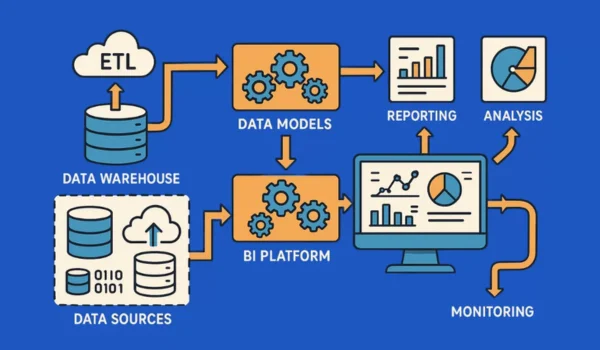
Key components of a BI model include:
- Data Collection: Gathering information from internal and external sources, like sales, marketing, supply chain, or customer interactions.
- Data Storage: Using databases or cloud platforms to store large volumes of structured and unstructured data.
- Data Analysis: Applying statistical tools, AI, or machine learning algorithms to extract meaningful insights.
- Reporting & Visualization: Presenting insights through dashboards, charts, and reports for easy interpretation.
How Business Intelligence Companies Make Money
Business Intelligence companies have built profitable business models by helping organizations unlock the value of their data. Here’s how they generate revenue:
- Software Licensing and Subscriptions
Most BI companies sell software solutions that allow businesses to collect, process, and analyze data. Revenue models often include:
- Per-user licenses: Companies pay a fee for each user accessing the BI platform.
- Enterprise licenses: Large organizations pay a fixed fee for company-wide access.
- Subscription plans (SaaS model): Customers pay recurring monthly or annual fees, often including updates and cloud hosting.
Example: Companies like Tableau, Power BI, and Looker follow subscription-based pricing to create steady, recurring revenue streams.
- Implementation and Consulting Services
BI platforms often require professional support for setup, customization, and integration with existing systems. BI companies charge consulting and implementation fees, which can be substantial for large enterprises.
This revenue stream includes:
- Custom dashboard creation
- Data migration and cleaning
- Integration with ERP, CRM, or other enterprise systems
- Data Analytics Services
Some BI companies go beyond software and offer data analytics as a service. They help businesses:
- Identify trends in customer behavior
- Forecast sales and revenue
- Optimize supply chain operations
- Monitor market competition
Charging for analytics services allows BI companies to monetize their expertise in addition to their software.
- Training and Support
BI tools can be complex, and organizations often require training for employees. Companies earn money by offering:
- Online or on-site training sessions
- Certification programs
- Technical support subscriptions
This also enhances customer retention, as trained teams are more likely to continue using the platform.
- Advanced Add-Ons and Custom Solutions
Many BI companies offer premium add-ons, including:
- AI-driven predictive analytics
- Real-time reporting modules
- Cloud storage or enhanced security features
These premium features are typically sold at higher price points, boosting revenue.
Key Components of a Successful Business Intelligence Model
The success of BI companies lies in how they structure their model. Some key elements include:
- Scalable Software Architecture
- Platforms should handle small businesses to enterprise-level clients without performance issues.
- User-Friendly Design
- Intuitive dashboards and visualization tools increase adoption and customer satisfaction.
- Integration Capabilities
- Ability to connect with multiple data sources, including CRM, ERP, and marketing platforms.
- Analytics and Insights
- Providing actionable insights, not just raw data, differentiates top BI providers.
- Flexible Pricing
- Offering tiered pricing for different business sizes helps capture a wider market.
Why the Business Intelligence Model Works
BI has become a critical part of business strategy in the USA for several reasons:
- Data-Driven Decision Making: Companies can make faster, more accurate decisions.
- Cost Optimization: BI helps identify inefficiencies and reduce operational costs.
- Revenue Growth: Analyzing customer behavior and market trends leads to better sales strategies.
- Competitive Advantage: Organizations using BI can stay ahead by spotting trends and risks early.
- Recurring Revenue: For BI providers, subscription-based models ensure predictable income.
Challenges in the Business Intelligence Industry
While BI is profitable, companies face challenges:
- High Competition: Many BI tools are available, from large players to niche startups.
- Data Privacy & Security: Handling sensitive business and customer data requires robust security measures.
- Integration Complexity: Businesses often struggle to unify data from multiple sources.
- User Adoption: Employees may resist new tools, requiring extensive training.
Future Trends in Business Intelligence
The BI landscape is evolving rapidly with emerging trends:
- AI & Machine Learning Integration: Predictive analytics and AI-driven recommendations are becoming standard.
- Cloud-Based BI: SaaS BI platforms reduce IT costs and improve scalability.
- Self-Service BI: Empowering non-technical employees to create reports and dashboards.
- Mobile BI: Accessing analytics on smartphones and tablets for on-the-go decision-making.
- Real-Time Analytics: Businesses increasingly demand instant insights for quicker actions.
Conclusion
The Business Intelligence model is a powerful framework for transforming data into actionable insights. BI companies make money through software subscriptions, consulting, analytics services, training, and premium add-ons, creating multiple revenue streams. For organizations, BI tools improve decision-making, reduce costs, and drive growth, while for BI providers, the model ensures scalable, recurring revenue.
In the USA, where competition and market dynamics are fierce, adopting a BI strategy or investing in BI solutions is no longer optional—it’s a critical factor for long-term success. Understanding the BI business model offers valuable lessons in monetization, customer focus, and innovation, applicable not only to tech companies but across all industries.
About the Author