You check your bank account and see a $12 monthly maintenance fee deducted. It may not seem like a big deal at first—but over a year, that’s $144 gone, and over 5 years, it’s more than $700 lost for nothing.
For millions of Americans—especially those living paycheck to paycheck—these fees quietly eat into savings.
The good news?
👉 You don’t have to pay bank fees anymore.
In 2026, many US banks offer no monthly fee accounts, no minimum balance, and even extra benefits like cashback, early direct deposit, and high interest.
In this guide, I’ll show you:
- The best no-fee banks in the US
- How to choose the right one
- Real examples and comparisons
- Tips to avoid hidden charges
What Does “No Monthly Fee” Really Mean?
Before choosing a bank, understand this clearly.
A no monthly fee bank account means:
- No maintenance charges
- No minimum balance requirement (in most cases)
But be careful…
👉 Some banks say “no fee” but still charge for:
- ATM usage
- overdrafts
- paper statements
So always read the details.
Best No Monthly Fee Banks in the US (2026)
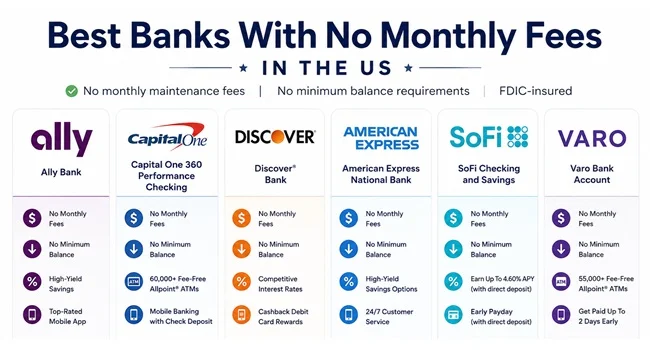
Here are some of the most trusted options:
- Chime
Why it’s popular:
- No monthly fees
- No minimum balance
- Early direct deposit (up to 2 days early)
Best for:
👉 Beginners and low-income users
Example:
If you earn $2,500/month in Chicago, getting paid 2 days early can help avoid late bill payments.
- Capital One (360 Checking)
Key features:
- No monthly fees
- No overdraft fees (optional settings)
- Large ATM network
Best for:
👉 People who want both online and physical bank access
- Ally Bank
Why choose Ally:
- No monthly fees
- High-yield savings account
- 24/7 customer support
Best for:
👉 Saving money and earning interest
- Discover Bank
Features:
- No monthly fees
- Cashback debit (rare feature)
- Free checks
Best for:
👉 People who want rewards on spending
- SoFi
Benefits:
- No account fees
- High interest rates
- Early paycheck access
Best for:
👉 Young professionals and gig workers
- Wells Fargo (with conditions)
⚠️ Important:
- Monthly fee can be waived (not fully free by default)
How to avoid fee:
- Maintain minimum balance OR
- Set up direct deposit
Best for:
👉 People who prefer traditional banks
Comparison Table: Best No-Fee Banks
| Bank | Monthly Fee | Minimum Balance | Special Feature | Best For |
| Chime | $0 | $0 | Early paycheck | Beginners |
| Capital One | $0 | $0 | Large ATM network | All users |
| Ally Bank | $0 | $0 | High savings interest | Savers |
| Discover Bank | $0 | $0 | Cashback debit | Smart spenders |
| SoFi | $0 | $0 | High interest + benefits | Young professionals |
| Wells Fargo | Waivable | Varies | Physical branches | Traditional users |
Step-by-Step: How to Choose the Right No-Fee Bank
Step 1: Decide Online vs Traditional Bank
- Online banks → Lower fees, higher interest
- Traditional banks → Physical branches
👉 Example:
- New York resident → may prefer branch access
- Remote worker → online bank is enough
Step 2: Check ATM Access
Some banks charge ATM fees.
👉 Look for:
- Free ATM networks
- Reimbursement policies
Step 3: Look at Extra Benefits
Choose based on your needs:
- Cashback → Discover
- Savings → Ally
- Early salary → Chime
Step 4: Review Hidden Charges
Always check:
- Overdraft fees
- Foreign transaction fees
- Wire transfer costs
Real-Life Example
Case Study: Sarah (Los Angeles)
- Salary: $3,200/month
- Old bank fees: $12/month
What she did:
- Switched to Capital One
- Saved $144/year
- Used savings account for emergency fund
👉 Result:
More control over money without changing income
Smart Tips to Avoid Bank Fees
✔ Choose banks with no overdraft fees
✔ Use in-network ATMs
✔ Enable account alerts
✔ Avoid unnecessary add-ons
✔ Keep track of transactions
Strategies to Maximize Benefits
- Combine Checking + Savings
Example:
- Checking → daily expenses
- Savings → emergency fund
- Automate Savings
- Set auto-transfer every month
- Even $100/month grows fast
- Use Cashback Accounts
- Earn while spending
Common Mistakes to Avoid
❌ Choosing bank based only on ads
❌ Ignoring hidden fees
❌ Not checking ATM network
❌ Keeping all money in checking
❌ Not reading terms & conditions
Who Should Choose No-Fee Banks?
👉 Perfect for:
- Students
- Low-income families
- Freelancers
- Anyone tired of paying unnecessary fees
FAQs
- Are no-fee banks safe in the US?
Yes, if they are FDIC-insured, your money is protected up to $250,000.
- Can I open these accounts online?
Yes, most banks like Chime and Ally Bank allow full online setup.
- Do no-fee banks have hidden charges?
Some do—always check overdraft and ATM fees.
- Which bank is best for beginners?
Chime is one of the easiest to use.
- Can I switch banks easily?
Yes, you can open a new account and transfer funds anytime.
Final Action Plan (What You Should Do Next)
If you want to stop wasting money on bank fees, follow this:
Step-by-Step:
- Review your current bank fees
- Choose a no-fee bank (from list above)
- Open account online (10–15 minutes)
- Transfer your money
- Set up direct deposit
- Close old account (if not needed)
Final Thought
Bank fees are one of the easiest expenses to eliminate.
You work hard for your money—there’s no reason to give it away in unnecessary charges.
👉 Switching to a no-fee bank is a small step with a big financial impact.
Start today, and keep more of your money where it belongs—with you.
About the Author