If you’re starting your investment journey in the United States, you’ve probably heard two popular terms:
👉 Index Funds
👉 ETFs (Exchange-Traded Funds)
Both are beginner-friendly, low-cost, and widely recommended by financial experts. But many people get confused:
👉 Which one should I choose?
👉 Are they the same or different?
In this easy-to-understand guide, I’ll explain everything step-by-step so you can confidently decide what’s best for your financial goals.
💡 What Are Index Funds?
An index fund is a type of mutual fund that tracks a market index.
📊 Example:
- Vanguard 500 Index Fund Admiral Shares
- Tracks the S&P 500 (top 500 US companies)
✔ How It Works:
Instead of picking individual stocks, the fund automatically invests in all companies within an index.
👉 You get instant diversification.
✔ Key Features:
- Professionally managed
- Long-term focus
- Bought directly from fund companies
💡 What Are ETFs?
An ETF (Exchange-Traded Fund) is similar to an index fund—but it trades like a stock on the stock market.
📊 Example:
- Vanguard S&P 500 ETF
- SPDR S&P 500 ETF Trust
✔ How It Works:
- Tracks an index (like S&P 500)
- Bought and sold anytime during market hours
✔ Key Features:
- Real-time trading
- Low cost
- Available through brokerage apps
🤔 Are Index Funds and ETFs the Same?
👉 They are similar—but not identical.
Both:
✔ Track market indexes
✔ Offer diversification
✔ Have low fees
But they differ in how they are bought, sold, and managed.
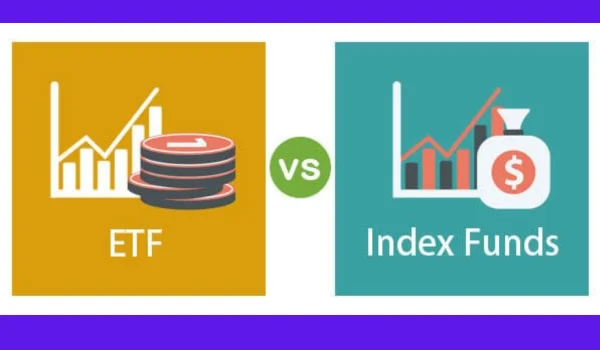
📊 Index Funds vs ETFs (Side-by-Side Comparison)
| Feature | Index Funds | ETFs |
| Trading Style | Once per day (end of day) | Real-time (like stocks) |
| Minimum Investment | Often $500–$3,000 | As low as $1 (fractional) |
| Fees (Expense Ratio) | Low | Very low |
| Ease of Use | Simple | Slightly more flexible |
| Best For | Long-term investors | Beginners & active investors |
| Tax Efficiency | Moderate | High |
💰 Cost Comparison (Very Important)
Both options are low-cost, but ETFs usually have a slight edge.
📌 Example:
- Index fund fee: 0.05%–0.10%
- ETF fee: 0.03%–0.08%
👉 Over time, even small differences matter.
📈 Tax Efficiency (Big Advantage for ETFs)
In the U.S., taxes play a big role in investing.
✔ ETFs:
- More tax-efficient
- Lower capital gains taxes
✔ Index Funds:
- May distribute taxable gains
👉 ETFs are generally better for taxable accounts.
🧠 Ease of Investing
✔ Index Funds:
- Invest a fixed amount easily
- Automatic investing (monthly SIP)
- No need to track market timing
✔ ETFs:
- Requires buying during market hours
- Prices fluctuate during the day
👉 Index funds are simpler for beginners who want a “set and forget” strategy.
💡 Flexibility & Control
✔ ETFs Offer More Flexibility:
- Buy/sell anytime
- Use limit orders
- Trade like stocks
✔ Index Funds:
- No intraday trading
- Less control
👉 If you want control → ETFs
👉 If you want simplicity → Index fund
🧾 Real-Life Example
Let’s say you live in California and want to invest $1,000.
Option 1: Index Fund (VFIAX)
- Invest $1,000
- Price updates at end of day
Option 2: ETF (VOO)
- Buy shares anytime
- Price changes throughout the day
👉 Both give similar returns—but different experience.
🧠 Which Is Better for Beginners?
👉 Choose Index Funds If:
✔ You want simplicity
✔ You prefer automatic investing
✔ You are investing for long-term goals
✔ You don’t want to track market daily
👉 Choose ETFs If:
✔ You have small starting capital
✔ You want flexibility
✔ You use mobile apps like Robinhood
✔ You want better tax efficiency
💰 Investment Strategy for Beginners
You don’t need to choose only one.
👉 You can combine both.
✔ Example Portfolio:
| Investment Type | Allocation |
| ETF (VOO) | 60% |
| Index Fund | 40% |
👉 This gives flexibility + stability.
⚠️ Common Mistakes to Avoid
❌ 1. Overthinking the Choice
Both are excellent—just start investing.
❌ 2. Chasing Short-Term Gains
Focus on long-term growth.
❌ 3. Ignoring Fees
Choose low-cost funds.
❌ 4. Not Diversifying
Don’t invest in just one asset.
❌ 5. Timing the Market
Invest regularly instead.
📈 Long-Term Returns (Reality Check)
Both index funds and ETFs deliver similar returns because they track the same index.
📊 Example:
- S&P 500 average return: ~10% annually
👉 Whether ETF or index fund—you get similar growth.
💡 Pro Tips from Investment Experts
✔ Start early—even with small amounts
✔ Invest consistently (monthly)
✔ Reinvest dividends
✔ Stay invested during market ups and downs
🔄 Future of Investing in the US
ETFs are growing rapidly because:
- Lower costs
- More flexibility
- Easy access via apps
👉 But index funds are still preferred for retirement accounts like 401(k) and IRAs.
🏁 Final Verdict: Which Is Better?
👉 There is no one-size-fits-all answer.
🥇 ETFs Are Better If:
- You want flexibility
- You have small capital
- You care about tax efficiency
🥇 Index Funds Are Better If:
- You want simplicity
- You invest regularly
- You prefer long-term automation
📌 Simple Rule to Remember
👉 “If you want ease → Index Funds”
👉 “If you want flexibility → ETFs”
🧠 Final Thoughts
Both index funds and ETFs are powerful tools for building wealth in the U.S.
You don’t need to choose the “perfect” option.
👉 The most important thing is:
- Start investing
- Stay consistent
- Think long-term
Your financial future depends more on your discipline than your choice of fund.
About the Author